Before the case was dismissed, people went looking. What they found has been almost entirely forgotten.
The five-page document that started everything arrived at the offices of Quest International, a small civilian UFO research magazine based in Batley, West Yorkshire, England. Quest had grown out of the Yorkshire UFO Society and was run by a retired police sergeant named Tony Dodd. Dodd had spent thirty years with the North Yorkshire constabulary before devoting himself to investigating UFO reports full-time. He was methodical, careful, and had no patience for fantasists. In a field that attracted more than its share of attention-seekers, Dodd was one of the few people with a genuine investigative background.
His first instinct when he read the fax was to throw it away. His second instinct, after reading it again, was to start making phone calls.
The SAS Tafelberg was a real ship in the South African Navy. AFB Swartkop was a real air force base. The Department of Air Force Intelligence, stamped on the header of the document, was a real division of South African military intelligence. The classification terminology, the unit designations, the procedural language — all of it tracked with how the South African military actually produced paperwork.
A colleague at Quest telephoned NORAD — the North American Aerospace Defense Command, the joint US-Canadian organisation that monitors air and space threats across North America — and asked the duty officer whether anything had been tracked entering that area on that date.
A faxed reply from Wright-Patterson Air Force Base referred to a satellite re-entry on 7 May 1988 — one year earlier than the document's date. Some sources date the Kalahari incident to 1988, others to 1989. Whether the discrepancy was a clerical error, a deliberate obfuscation, or evidence of two separate events has never been resolved.
Two independent researchers travelled to South Africa on their own initiative, without coordinating with each other. Dr J.J. Hurtak, an American academic and author on subjects ranging from linguistics to what he called future science, and Johannes von Buttlar, a German researcher and writer. Both came back saying that a crash landing of some kind had taken place in the Kalahari. Both said military personnel had confirmed sightings of an unidentified object in South African airspace.
A third unnamed researcher reportedly walked into the Kalahari itself and spoke with local tribesmen who had seen unusual things in the sky.
A former Lieutenant-Colonel of the United States Air Force was quoted in the Quest International investigation as saying that his contacts in American naval intelligence had told him the United States had given South Africa advanced technology in exchange for a UFO.
That claim — technology in exchange for a UFO — sounds outlandish in isolation. But South Africa and the United States had documented covert technology-sharing arrangements that predated the crash by over a decade. The ISC-Armscor-CIA pipeline, involving figures like Gerhardt Guerin and Bobby Inman, facilitated the transfer of prohibited technology to South Africa throughout the sanctions era.
In November 1989, six months after the alleged crash, a US federal indictment was filed for the smuggling of advanced gyroscope technology to South Africa — components essential for missile guidance and directed-energy weapon stabilisation. The infrastructure for secret technology transfers between the two countries was not theoretical. It was operational and documented.
South Africa's UFO history, though rarely discussed, predates the Kalahari incident by decades. The United States Air Force's own Project Blue Book — the official investigation into UFO sightings that ran from 1952 to 1969 — contains at least two entries from South Africa: a dark red torpedo-shaped object over Durban in February 1951, and a white semicircular flat object with a dome observed by a weather officer through a theodolite over the Cape Province in December 1954.
The Kalahari was not the first time something unexplained appeared in South African skies. It was the first time something was allegedly brought down.
In 1993, the Cape Town Argus — one of South Africa's oldest daily broadsheet newspapers, established in 1857 — ran an article describing an international cover-up and a disinformation exercise aimed at blocking researchers. The article reportedly named Botswana's Environment Minister, Dithoko Seiso, as having confirmed the incident on the record.
• • •
The description of the recovered beings — small, hairless, grey-skinned, large dark eyes, three fingers, three toes — is worth pausing on. This description was committed to paper in 1989. It predates the mass popularisation of the so-called grey alien archetype by several years.
It predates the Ariel School encounter in Ruwa, Zimbabwe, in 1994, where sixty-two schoolchildren independently drew beings matching the same description without being exposed to each other's accounts. That case was investigated by the late Dr John Mack of Harvard University and remains one of the most studied and least explained incidents in the field.
Whether the Kalahari document drew from earlier UFO literature or described something actually observed, the overlap with descriptions that surfaced later and independently is a data point that has not been addressed.
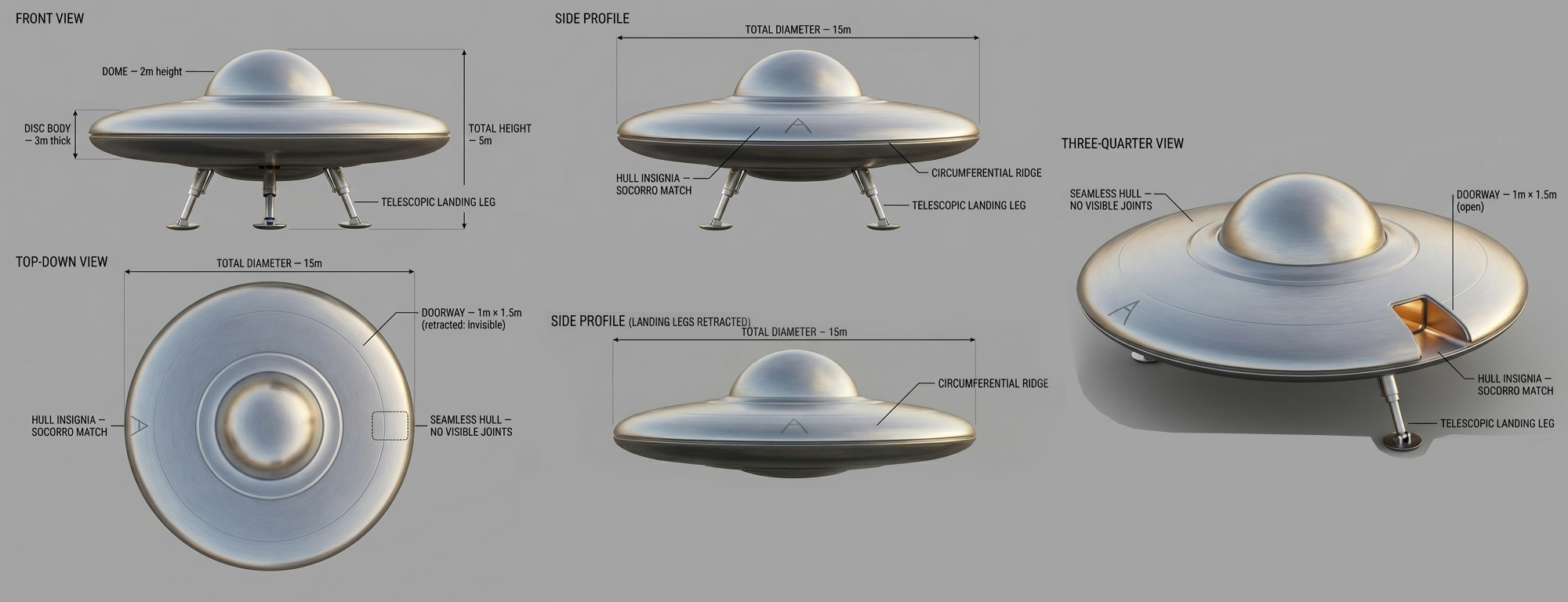
The three-fingered, three-toed motif did not originate with the Kalahari documents and did not end with them. In 1964, police officer Lonnie Zamora witnessed a landed craft near Socorro, New Mexico, and described a smooth, seamless metallic hull with an insignia and landing legs — details that match the Kalahari account almost exactly, written twenty-five years apart by people with no known connection. In the 2010s, the controversial Nazca bodies presented in Peru — whatever their provenance — were described as three-fingered and three-toed, the same configuration as the Kalahari entities. The motif persists across decades and continents in a way that either suggests a shared source or an extraordinarily consistent fabrication tradition.
There is also an African dimension to these descriptions that Western UFO researchers have largely ignored. Credo Mutwa, the renowned Zulu sangoma and traditional historian, appeared on South African television with hand-crafted figurines depicting beings that matched the grey archetype in precise detail — large slanted eyes, slight builds, elongated heads. Mutwa claimed these figures had been in the possession of African nations for generations and that indigenous Southern African communities had traditions of contact with these beings stretching back centuries. His testimony is independent of Western UFO culture. It predates the internet. And it describes the same type of being that the Kalahari documents claim was pulled from a crashed disc in 1989.
Entity Description Comparison — 1989 vs 1994
| Feature |
Kalahari 1989 |
Ariel School 1994 |
|
| Craft shape |
Disc, 15m, raised dome, brushed aluminium |
Silver disc, dome-shaped, lands silently |
✓ |
| Entity height |
4–5 feet (approx. 1.2–1.5m) |
Approx. 1 metre (3–4 feet) |
✓ |
| Eyes |
Large, slanted, dark — minimal facial features |
Large elongated dark eyes, lower on face |
✓ |
| Clothing |
Tight-fitting suits with unknown insignia |
Tight black one-piece suits |
✓ |
| Mouth / Nose |
Small mouth, negligible nose |
Small or slit-like mouth, minimal nose |
✓ |
| Body build |
Slight build, small stature |
Thin body, large head, short legs |
✓ |
| Investigator |
Cynthia Hind (assessed 1989) |
Cynthia Hind (investigated 1994) |
✓ Same |
| Source |
Leaked classified document |
62 independent child witnesses |
No coordination possible |
Southern African Parallels: Loxton 1975 — small, pale, slanting eyes, cream overalls (farmer Danie van Graan, Northern Cape, ~280km from Vastrap). Despatch 1978 — three silvery-clad beings, Eastern Cape. Both investigated by Cynthia Hind. The convergence is not between two data points — it is between five or more independent data points spanning three decades and three countries.
All of this — the NORAD confirmation, the Wright-Patterson response, the Hurtak and Von Buttlar trips, the USAF Lieutenant-Colonel's quote, the Argus article, the Blue Book precedents, the being descriptions that predate their own archetype — existed in the record before the case was closed. None of it was followed up.
Because what closed the case was a woman named Cynthia Hind — the most rigorous UAP researcher in Africa, MUFON's coordinator for the continent, who published 22 issues of UFO Afrinews between 1988 and 2000 — who traced the documents to a man named James Van Greunen. And what she found about the additional documents he produced was damning enough to shut everything down.
The original five-page document — the one with the SAAF crest, the correct institutional scaffolding, and fourteen spelling mistakes — was never shown to be inauthentic. It was the additions that were fake. The core document has sat for over three decades, neither proven real nor proven forged.
Hind added a qualification that is almost always omitted when her assessment is quoted: the documents described an institutional context — the weapons testing, the radar capabilities, the classified research programmes, the covert American presence — that was real, verified, and documented through entirely independent sources. As she put it: 'The documents are almost certainly fabricated. But the world they describe is real. That's what makes this case so difficult to dismiss entirely.'
Fourteen spelling mistakes in a classified military report. That number is either proof of a clumsy forgery, or the fingerprint of something else: a document reconstructed from memory by someone who had read the real thing but could not take it with him.