The man who sent the fax. The confession nobody expected.
Part 7 of 10 · Alt Afrikaner · 2026
Scroll
James Hendrik van Greunen was born on 21 April 1965 in Johannesburg. At fourteen he joined MUFON — the Mutual UFO Network, an American-founded civilian organisation that collects and investigates UFO sighting reports worldwide — listing his areas of expertise as model rockets and astronomy. At fifteen he stood in front of a room full of adults in Johannesburg and told them he was a contactee, a person who had been in direct communication with extraterrestrial beings.
He suffered from epilepsy. He entered the South African military at some point in his late teens and was discharged when the condition was discovered. He married young, had two children, left his family in England in 1988, and surfaced in 1989 with a story about a crashed UFO and a set of classified documents.
The Trail of Fabrication
The Forgeries
The additional documents he produced — beyond the original five pages — were forgeries. Photocopied passport seals, text retyped from American UFO conspiracy publications, passages pasted together from multiple sources. Cynthia Hind traced them to him. He did not deny it.
He founded a UFO organisation called NUFORIN, sold conference tickets, and disappeared to Germany. He was convicted of fraud in Bavaria. He underwent a sex change operation and resurfaced years later as Dr Judy Fältskog, claiming to be a NASA astrophysicist. That identity collapsed within hours when an online investigation by members of AboveTopSecret.com — one of the internet's largest conspiracy and investigation forums — found no academic record, no publications, and no NASA affiliation. Every online profile associated with Fältskog was subsequently deleted.
By any reasonable measure, Van Greunen is a serial fabricator. The trail of fraud, identity changes, and discredited claims stretches across three continents and three decades.
A Backroom in Germany
The Confession
And then there is what happened in a backroom at a UFO conference in Germany in the early 1990s. Van Greunen sat down with Tony Dodd and admitted the additional documents were fakes.
Then he said the original five pages were his attempt to reconstruct a real classified report shown to him by his school friend, Captain Hendrik Greef, a serving pilot in the SAAF. He could not photograph the original. He could not photocopy it. He read it, went home, and typed what he remembered.
Key Distinction
A forger trying to create a convincing fake would proofread it.
A man typing from memory would get the institutional framework right — the unit names, the stamps, the procedural language — but stumble on spelling.
Recall fills in structures and drops details. That is what fourteen spelling mistakes in an otherwise institutionally accurate document looks like.
Van Greunen presented what appeared to be a South African military intelligence identification card. He showed documents he said confirmed his participation in Operation Silver Diamond. Dodd did not say he believed him. He said he could not walk away from what he was hearing.
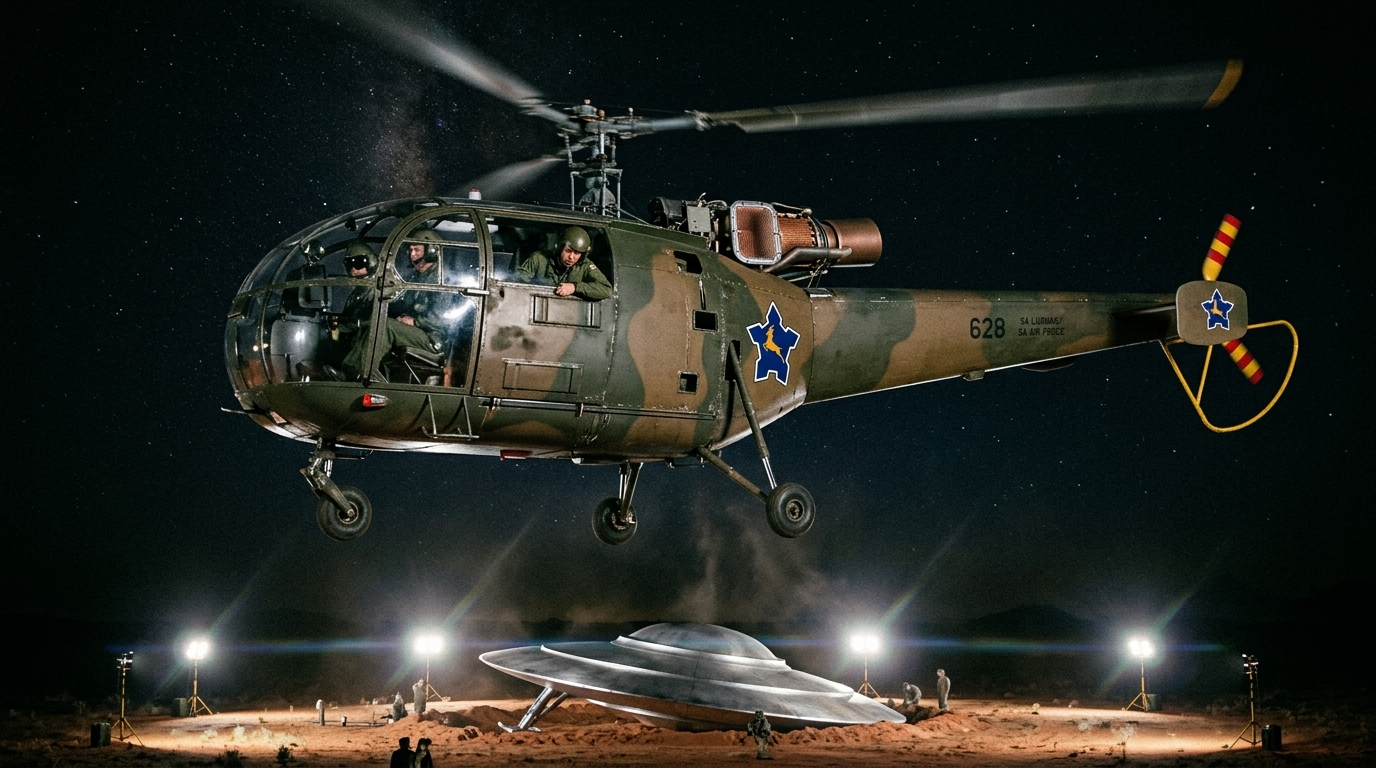
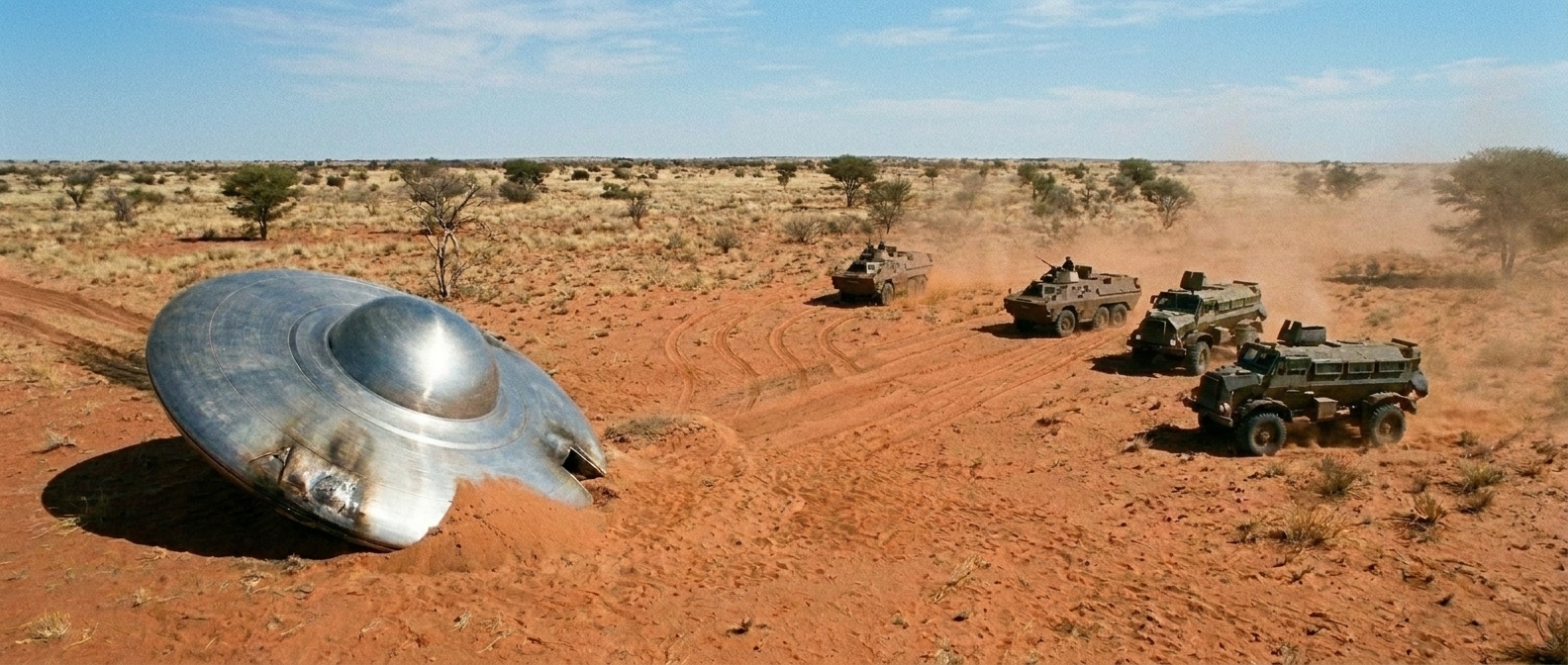
The recovery site as the five pages describe it — floodlights, helicopters, and a disc in a crater of fused sandOperation Silver Diamond — the recovery operation Van Greunen claimed to have participated in
There were things that did not fit a simple fraud. The threatening phone calls from the South African embassy in London, which Dodd recorded. The surveillance at the airport when Dodd collected Van Greunen, which Dodd witnessed personally. The death threats Dodd received after speaking publicly about the case.
A contact inside the South African military told Dodd he was safe only because foreign governments would not risk the political consequences of having him killed in his own country.
Note
Embassies do not make threatening phone calls to con artists.
Intelligence services do not put surveillance teams on fantasists.
Something in those five pages touched something real.
A Documented Government Tactic
The Pattern
In 2024 and 2025, the Pentagon's own All-domain Anomaly Resolution Office — AARO, the body created by the United States government specifically to investigate unidentified aerial phenomena — confirmed that the US government had, at various points in its history, deliberately created and amplified UFO narratives to conceal classified weapons programmes. The purpose was to make real events uninvestigable by attaching the UFO label to them.
The South African government had been doing the same thing under its own doctrine. AEC employees were officially instructed to lie to IAEA inspectors. The uranium enrichment facility was named Valindaba — a Zulu word meaning 'about this we do not speak at all.' Cover stories were not an emergency response to discovery. They were institutional policy, staffed, funded, and maintained with the same rigour that went into the programmes they concealed. A UFO narrative deployed to cover a classified incident in the Kalahari is not a leap of imagination. It is a logical application of existing infrastructure — a story so outlandish it discredits itself.
If that is a documented government tactic, then the Van Greunen pattern fits: a real event generates a real document, the document is seen by someone who cannot copy it, a reconstruction is produced, the reconstruction is padded with fabrications, the fabrications are exposed, and the original truth disappears beneath the debris of the debunking.
It is the same structure as the Alien Autopsy.
In 2006, Ray Santilli admitted his Roswell autopsy footage was staged but claimed he had seen genuine footage on deteriorating film in 1992 and had reconstructed what he remembered. See the real thing. Fail to secure it. Rebuild from memory. Get caught. Watch the original vanish.
Unverified
According to a contact Dodd maintained inside the South African military, while two of the recovered beings and the wreckage were transferred to Wright-Patterson, a third being — unknown to the Americans — was retained at an undisclosed location in South Africa.
Some accounts refer to this facility as Camp 13, described as an underground installation in the Kalahari. No physical evidence of Camp 13 has been produced. No satellite imagery has confirmed it. But the claim exists in the record, and nobody has gone looking.
There is a final detail about the documentary record that has received almost no attention. On 24 March 1993 — the same day President F.W. de Klerk addressed the South African Parliament to publicly acknowledge the nuclear weapons programme for the first time — officials at Armscor, the state arms procurement agency, destroyed the last remaining policy documents from the nuclear weapons programme.
This destruction was legally authorised as part of South Africa's accession to the Nuclear Non-Proliferation Treaty. But its effect was to erase the institutional memory of South Africa's most sensitive military programmes from the 1970s through 1989 — exactly the period encompassing the alleged Kalahari crash.
Whatever records Armscor held about weapons testing in the Kalahari, about the Thor programme, about Kentron's directed-energy research, about the Israeli engineering partnership — all of it went through the shredders on the same day the President told the world the bombs had existed. The standard investigative approach — find the official documents, verify or refute — is permanently foreclosed. The documents were destroyed. That is not the same as the events never having happened. It means the paper trail was deliberately removed.
Something in those five pages touched a nerve.
The fourteen mistakes may be the clearest clue to what: not a forgery, but a reconstruction. A document typed from memory by someone who had read the real thing but could not take it with him. The institutional detail came from the original. The spelling errors came from the limits of human recall.
• • •
Forgery or reconstruction. That is the question that runs under this entire story. And the answer depends not on what Van Greunen was — because what he was is well documented and deeply compromised — but on whether a compromised source can still carry a real signal inside the noise.
The five pages have never been proven real. They have never been proven fake. The institutional scaffolding checks out. The military geography checks out. The weapon description, when correctly identified, checks out. The nuclear-site pattern checks out. The NORAD confirmation exists. The Wright-Patterson response exists. The Cape Town Argus article existed until someone removed it from the newspaper's own archive.
And the same suburb where the source lived, where the base sits, and where the weapons were made produced a senior police officer who went on national television and said he chased something through the sky that he could not explain.
The original five pages have never been shown to be forged. The institutional detail is accurate. The weapon is plausible. The location matches the pattern. And the government response does not match what you would expect if the story were simply made up.