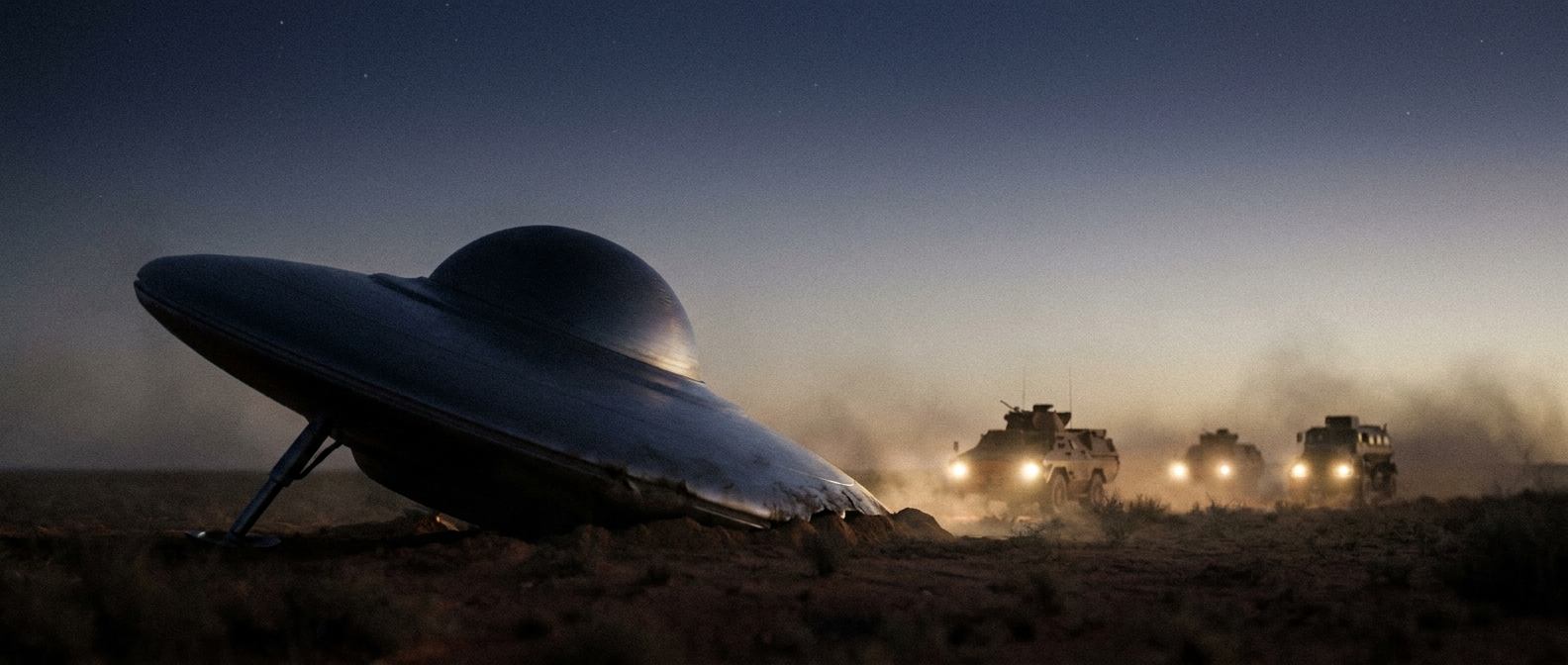
Centurion is a suburb of Pretoria, the administrative capital of South Africa. It sits about fifteen kilometres south of the city centre. Neat streets, brick houses, shopping centres, schools. It is the kind of place where civil servants and military families lived. It does not look like the kind of place where a crashed UFO story, a nuclear weapons programme, and an international intelligence operation would intersect.
But the geography of this story converges there in a way that has never been publicly noted.
Convergence
Node 1: James Van Greunen, the man who sent the Kalahari documents to Tony Dodd, lived in Centurion.
Node 2: AFB Swartkop — the SAAF's oldest base, established 1921, housing intelligence and transport operations — referred to as Valhalla, where the recovered craft was allegedly taken before being shipped to Wright-Patterson — sits in Centurion.
Node 3: The headquarters of Kentron, the weapons division of Armscor that designed the Seeker drone, the ARD-10, the electronic warfare systems, and was conducting directed-energy research with Israeli engineers — was in Centurion. Today it operates as Denel Dynamics from the same address.
This geographic convergence has never been reported in any published account of the Kalahari incident. It is, as far as this investigation can determine, an original finding. And it matters because it changes the nature of the question about Van Greunen. If he was a random fantasist fabricating a story from newspaper clippings and UFO magazines, the Centurion connection is a coincidence — he happened to live near the base and the weapons manufacturer he wrote about. But if he was someone with actual proximity to the people and institutions described in the documents, the convergence is not a coincidence. It is geography confirming access.
That is either a coincidence, or it is what proximity looks like when someone is describing a world they actually lived in rather than one they invented.
There is another detail about Centurion that does not appear in the Kalahari literature but belongs here. On 28 August 1996, seven years after the alleged crash, a UAP incident began in Erasmuskloof — a suburb adjacent to the Centurion Node — and escalated into the most documented police encounter with an unidentified object in South African history.
At 4:00 AM, Sergeant Nico Stander of the Adriaan Vlok police station in Erasmuskloof began filming a glowing disc visible over the southern suburbs of Pretoria. The pulsating disc contained a red triangular light and at one point emitted what witnesses described as bright green tentacles of light. The sighting quickly escalated: the Flying Squad was called, then SWAT, then canine units, then mobile units from across Pretoria. Some 200 police officers were eventually involved.
On Record
A Bo-105 police helicopter with five officers aboard took to the air at 5:30 AM, piloted by Superintendent Fred Viljoen. Viljoen was an experienced pilot who had never believed in UFOs. The helicopter spotted the object over Mamelodi and gave chase. The object performed vertical and horizontal undulating movements, outpacing the helicopter at its maximum speed. Viljoen radioed the control tower at AFB Waterkloof — the SAAF base adjacent to the Centurion Node — and was told that their radar was showing 'clutter' in the area the object was flying.
Viljoen said publicly: 'It is the first time in my life that I have seen anything like this.' The chase continued toward Cullinan and ended when the helicopter's fuel ran low and the object made a vertical ascent to an altitude where no helicopter could follow.
The chase ended near Bronkhorstspruit — the same highway where Constables Lockem and De Klerk had watched a copper disc lift off the road thirty-one years earlier in September 1965. The same corridor keeps appearing. That is not nothing.
The case was reported by SABC Television. The video was broadcast nationally. Superintendent Viljoen gave public interviews. Ster Kinekor, a South African film distribution company, telephoned a Cape Town radio station and claimed the sighting was a promotional stunt. On the evening news broadcast, Viljoen — in uniform, on camera — denied it. He said the helicopter had five people on board and all of them agreed it was not an aircraft.
And then — as always, as consistently across the entire South African UAP record — official silence descended. No explanation was offered. No investigation was publicly announced. The footage exists. The radar record exists at AFB Waterkloof. Two hundred police officers witnessed an event that was never officially explained.
There is one more layer to the Centurion geography that has not been explored. The documents refer to AFB Swartkop by the name Valhalla. In Norse mythology, Valhalla is the hall where warriors go after death — a place of honour for those who fell in battle. It is an unusual name for an air force base in a Pretoria suburb. Whether it was an official designation, a colloquial nickname used by personnel, or a deliberate choice by whoever wrote the document is unknown. But it is the kind of detail that an insider would use naturally and an outsider would be unlikely to invent. People who live near military bases know the nicknames. People who fabricate stories from a distance tend to use the names they find on maps.
Same suburb as Van Greunen. Same suburb as the air force base. Same suburb as the weapons manufacturer. A police superintendent, on camera, in uniform, saying he chased something through the sky that he could not explain, directly above the place where the Kalahari documents originated. And the only attempt to explain it away — a phone call from a film company — was contradicted on live television by the man who was in the helicopter.