On 8 May 2026, the United States Department of War launched the PURSUE programme — the Presidential Unsealing and Reporting System for UAP Encounters — and released 162 previously classified UAP case files spanning from the late 1940s to 2025.
Four of those files related specifically to Africa.
Declassified
PR-001, PR-002, PR-003 — originated from the United States Africa Command (AFRICOM), the Pentagon's combatant command responsible for military operations on the African continent.
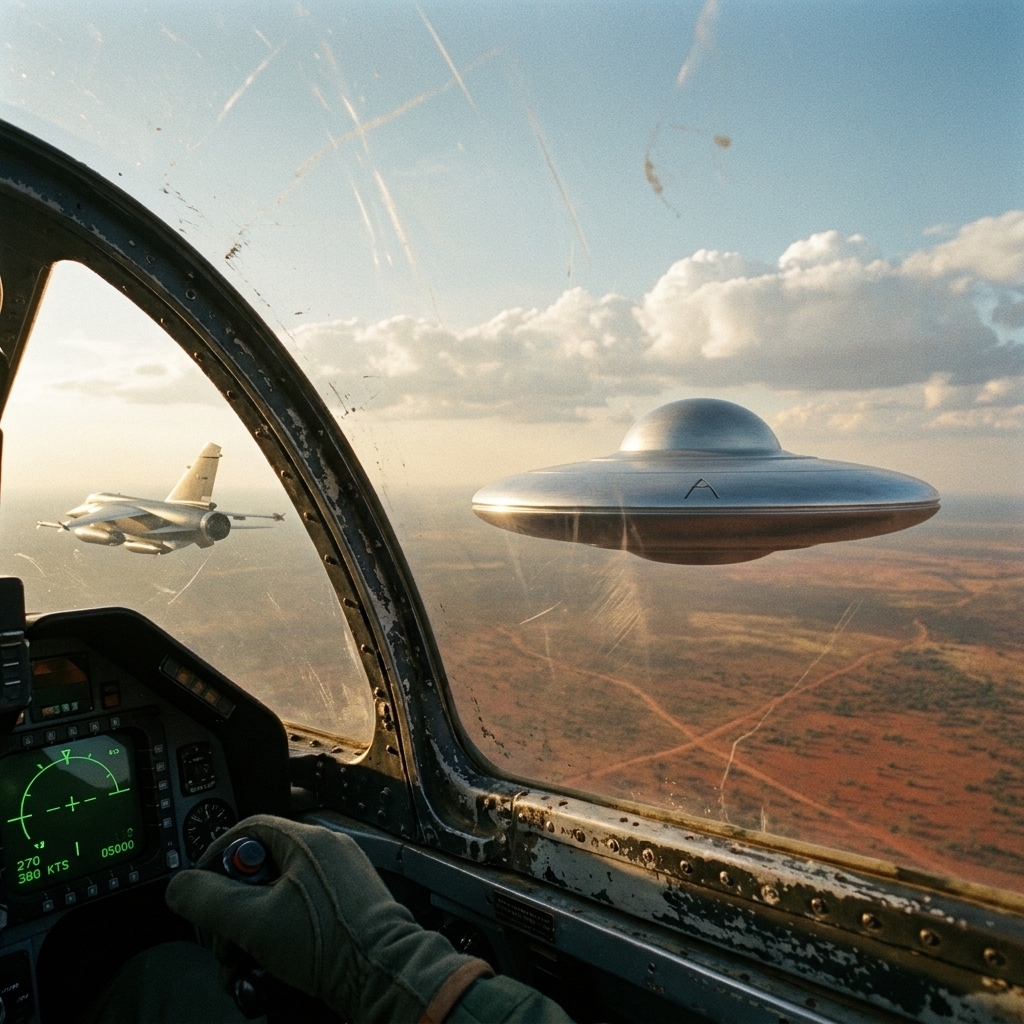
PR-043 — described a UAP encounter reported by a US military operator in African airspace as recently as 2025.
Two of the four African files remain officially unresolved — the United States government cannot explain what its own personnel observed over Africa.
The default assumption behind every dismissal of the Kalahari case has been that there is no reason for UAP activity over Africa. Why would unidentified aerial phenomena appear over the Kalahari? What interest could they possibly have in southern Africa?
The PURSUE release answers that question with the Pentagon's own declassified records. The interest exists. The activity has been documented. It continues into the present day.
There is older evidence too. Buried in the FBI's declassified archives is file 65-2877, an internal Bureau communication called an AIRTEL from the SAC Detroit field office, dated 1960. It documents a 1962 report describing a missile fired at a UFO over Africa.
The signals intelligence dimension has a specific relevance to the Kalahari that has not been discussed. In May 1989, the Northern Cape was saturated with electromagnetic emissions from missile testing, radar tracking, electronic warfare experiments, and the routine communications traffic of a military establishment on active duty.
The NSA's global monitoring network would have been recording those emissions as a matter of course — South Africa's nuclear and missile programmes were among the highest-priority intelligence targets of the late Cold War. If an anomalous electromagnetic event occurred in that region during that window — the kind of intense EM field described in the crash document, strong enough to bring down a helicopter at five hundred feet — it would have been detected.
The National Security Agency had been tracking UAP through its most sensitive systems since the 1960s. These systems were classified at the UMBRA level, the highest tier of communications intelligence security. They are the same systems that would have been monitoring electromagnetic emissions from the Kalahari during the May 1989 weapons testing window. Whether those systems detected anything unusual during that period is a question nobody has publicly asked.
In the years since the Kalahari incident, the scenario it describes has been repeated with more advanced sensors and the same result. In a now-documented encounter near the border between Jordan and Syria, a US military MQ-9 Reaper drone — a large, remotely piloted aircraft carrying some of the most advanced surveillance and targeting sensors in the American military inventory — achieved a weapons-grade sensor lock on a UAP. The object then demonstrated instantaneous acceleration beyond any known technology. The drone tracked it. The sensors confirmed what the operators saw.
• • •
The documents specify that the cargo was loaded onto two Galaxy C-2 aircraft — the Lockheed C-5 Galaxy, one of the largest military transport aircraft in the world, capable of carrying tanks, helicopters, and outsized cargo across intercontinental distances — and flown out accompanied by American Air Force personnel. The use of two C-5 Galaxys for a single shipment suggests either that the cargo was extremely large, extremely heavy, or that redundancy was built into the transport plan in case one aircraft was compromised.
Red Alert
On 23 June 1989 — forty-seven days after the alleged Kalahari crash, and the same date the documents claim the recovered material was loaded onto Galaxy C-2 transport aircraft for shipment — Wright-Patterson Air Force Base in Ohio was placed on Red Alert.
That is the highest security posture an American military installation can adopt short of actual combat.
No official explanation for the Red Alert has ever been given. The timing has never been investigated.